Theoretical computer science: the most famous cards
The free Wikipedia card game and general-knowledge games
197 cards
Mythics 5 Legendaries 68
 discrete model studied in computability theory, mathematics, physics, complexity science, theoretical biology and microstructure modeling
 system that represents numeric values using two symbols; 0 or 1
 Algorithm sequence of instructions to perform a task
 computational device relying on quantum mechanics
 competitive algorithm for searching a problem space
 Formal language set of strings of symbols that may be constrained by rules that are specific to it; words whose letters are taken from an alphabet and are well-formed according to a specific set of rules
 computer system that emulates the decision-making ability of a human expert
 data structure in tree form with 0, 1, or 2 children per node, sorted for fast lookup
 scheme for the transfer of quantum information from one system to a remote one using entanglement
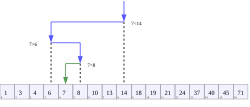 Binary search algorithm search algorithm in sorted lists that operates by decreasing the search space by half each pass
 Channel physical or logical connection used for transmission of information
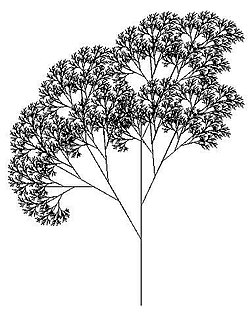 algorithmic technique in computer science of solving a problem by reducing it to a smaller instance of the same problem
 simple undirected graph in which every pair of distinct vertices is connected by a unique edge
 ordered tree data structure that organizes nodes by common key prefixes
 Activation function a function associated to a node in a computational network that defines the output of that node given an input or set of inputs
 gradient descent method used for the minimization of an objective function
 Word embedding technique in natural language processing that represents words as vectors in a continuous vector space
 method for analysis of algorithms
 Ramsey's theorem combinatorics theorem that any edge labeling of a sufficiently large complete graph contains monochromatic cliques
 well-quasi-ordering of finite trees
 sequence of characters that forms a search pattern
 abstract computation model; mathematical model of computation that defines an abstract machine which manipulates symbols on a strip of tape according to a table of rules
 specialized form of machine learning that uses artificial neural networks to identify patterns in data
 study of graphs, which are mathematical structures used to model pairwise relations between objects
 graph search algorithm
 branch of discrete mathematics
 1903 – 1957 Hungarian and American mathematician and physicist
 born 1947 British-Canadian computer scientist and psychologist
 Machine learning scientific study of algorithms and statistical models that computer systems use to perform tasks without explicit instructions
… and 44 more Legendary cards to discover in the game.
The 197 cards of Did you know Cards linked to “Theoretical computer science”, those closest to the topic first, then by fame (how often their Wikipedia article is read, and in how many languages): Cellular automaton, Binary numeral system, Algorithm, Quantum computer… The more famous the subject, the rarer its card.
Epics 85
- Sanjeev Arora — theoretical computer scientist
- Path — sequence of edges connecting a sequence of vertices in a graph, with no repeating vertices
- Decision problem — yes/no problem in computer science
- Quadtree — tree data structure in which each internal node has exactly four children
- Convex optimization — subfield of mathematical optimization
- Centrality — any measure of a node's level of connectedness within a mathematical graph
- Suffix tree — computer science term: compressed trie containing all the suffixes of the given text
- Bootstrap aggregating — ensemble method within machine learning
- Self-replicating machine — device able to make copies of itself
- Cook–Levin theorem — theorem that Boolean satisfiability is NP-complete and therefore that NP-complete problems exist
- Robert Tarjan — American computer scientist
- Quantum machine learning — Quantum Machine Learning combines quantum computing and ML to enhance algorithms, leveraging unique quantum properties, like superposition and entanglement, for efficient problem-solving
- Small-world network — mathematical graph where most nodes can be reached by a small number of steps
- Binary decision diagram — data structure
- Bekenstein bound — upper limit on entropy that can be contained within a given finite region of space which has a finite amount of energy, in physics
- Noga Alon — Israeli mathematician
- Lowest common ancestor — term in computer science
- Algorithmics — study of algorithms and data structures
- Star graph — node-link graph in which one central node is the only neighbor of all the other nodes
- Jacob Ziv — Israeli computer scientist
- Moore neighborhood — in cellular automata
- Polynomial hierarchy — hierarchy of complexity classes between P and PSPACE
- L (complexity) — complexity class (logarithmic space)
- E. Allen Emerson — American computer scientist
… and 61 more Epic cards to discover in the game.
In the Science booster
 Science 282,135 cards ›
About
Mythic 5 · Legendary 68 · Epic 85 · Rare 37 · Common 2
Fame score: Wikipedia page views (July 2015 – October 2026, 39 languages). Updated .
All these cards are won by opening boosters in Did you know Cards, the free card game where you learn as you play. All topics ›
All 197 “Theoretical computer science” cards in the game