Statistics: the most famous cards
The free Wikipedia card game and general-knowledge games
1,517 cards
Mythics 19
 study of the collection, analysis, interpretation, and presentation of data
 1820 – 1910 English social reformer, statistician, and founder of modern nursing
 Machine learning scientific study of algorithms and statistical models that computer systems use to perform tasks without explicit instructions
 programming language for statistical analysis
 Generation Z cohort succeeding Millennials, born from 1997 to 2012
 Millennials cohort succeeding Generation X, born from 1981 to 1996
 Standard deviation measure of the dispersion of the values of a random variable around its expected value
 cohort succeeding the Baby Boomers, born from 1965 to 1980
 study of the patterns, causes, and effects of health and disease conditions
 field of study
 probability distribution
 Intelligence quotient score from a test designed to assess intelligence
 relational database language that allows to extract from data tables a series of records with selection, sorting and computation criteria, or to update, delete or add records
 measure of inequality in income or wealth distribution
 language model built with very large amounts of texts
 fundamental theory in physics describing the properties of nature on an atomic scale
 1623 – 1662 French mathematician, physicist, inventor, writer, and Christian philosopher
 1777 – 1855 German mathematician and physicist
 an adage or epigram that is typically stated as: "Anything that can go wrong, will go wrong"
The 1,517 cards of Did you know Cards linked to “Statistics”, those closest to the topic first, then by fame (how often their Wikipedia article is read, and in how many languages): Statistics, Florence Nightingale, Machine learning, R… The more famous the subject, the rarer its card.
Legendaries 408
 Life expectancy statistical measure of how long a person or organism may live, based on factors of their life
 statistical principle about ratio of effects to causes
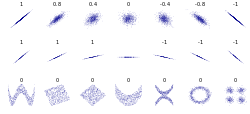 Correlation any statistical relationship, whether causal or not, between two random variables or bivariate data
 set of statistical processes for estimating the relationships among variables
 statistical approach for modeling the relationship between a scalar dependent variable and one or more explanatory variables
 interdisciplinary science that combines biology, computer science and statistics to help in the collection, analysis and understanding of biological data
 approximation method in statistics
 collection of statistical models used to analyze the differences between group means and their associated procedures
 set of data collected and/or selected from a statistical population by a defined procedure
 statistic; square root of the mean of the squares
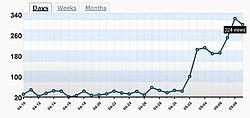 Descriptive statistics field of quantitative research
 statistical model
 method of estimating the parameters of a statistical model, given observations
 method of statistical inference
 statistical property quantifying how much a collection of data is spread out
 sigmoid shape special function which occurs in probability, statistics and partial differential equations
 Meta-analysis statistical method that summarizes data from multiple sources
 statistical method used to describe correlation through fewer possibly latent variables
 Sensitivity and specificity statistical measures of the performance of a binary classification test
 Probability measure of the expectation that an event will occur or a statement is true
 Variance expectation of the squared deviation of a random variable from its mean
 Data codified, fixed and transmissible information, that may be arranged for automatic processing
 Median middle quantile of a data set or probability distribution
 cohort born between 1946 and 1964, during the mid-20th century baby boom
… and 384 more Legendary cards to discover in the game.
Epics 495
- Reliability — consistency of a measure in psychometrics and statistics, that is if it produces similar results under consistent conditions
- Stationary process — stochastic process whose unconditional joint probability distribution does not change when shifted in time
- Exploratory data analysis — approach of analyzing data sets in statistics
- Homoscedasticity — statistical property
- Kaplan–Meier estimator — non-parametric statistic used to estimate the survival function
- Statistician — person who works with theoretical or applied statistics
- Baseball statistics — quantities observed and recorded for baseball players and games
- Difference in differences — social sciences statistical technique that mimics an experimental research design using observational study data by studying the differential effect of a treatment on a 'treatment group' versus a 'control group' in a natural experiment
- Boltzmann's entropy formula — equation in statistical mechanics
- Partial correlation — concept in probability theory and statistics
- Geostatistics — branch of statistics focusing on spatial data sets
- Conjoint analysis — statistical method
- Quantile function — statistical function that defines the quantiles of a probability distribution
- Wishart distribution — in statistics, a generalization to multiple dimensions of the chi-squared distribution or the gamma distribution
- Variogram — Spacial statistics function
- Credible interval — in Bayesian statistics, the interval within which an unobserved parameter value falls with a particular probability
- Life table — table which shows probability of death
- Quasi-experiment — empirical interventional study used to estimate the causal impact of an intervention on target population without random assignment
- Frequency domain — signal representation
- Simple random sample — type of sample
- Research ethics — ethical practice concerning scientific research
- Markov property — stochastic process satisfying a certain property
- Empirical distribution function — distribution function associated with the empirical measure of a sample
- Observational study — study that draws inferences from a sample to a population, in cases where the independent variable is not under the control of the researcher because of ethical concerns or logistical constraints
… and 471 more Epic cards to discover in the game.
In the Science booster
 Science 282,135 cards ›
About
Mythic 19 · Legendary 408 · Epic 495 · Rare 409 · Common 186
Fame score: Wikipedia page views (July 2015 – October 2026, 39 languages). Updated .
All these cards are won by opening boosters in Did you know Cards, the free card game where you learn as you play. All topics ›
All 1,517 “Statistics” cards in the game