Evolutionary biology: the most famous cards
The free Wikipedia card game and general-knowledge games
612 cards
Mythics 11
 change in heritable characteristics of biological populations over successive generations
 born 1941 English ethologist, evolutionary biologist and author
 one of the basic units of biological classification and a taxonomic rank
 Anus digestive track waste expulsion opening
 genus of mammals, includes 2 species: common chimpanzee and bonobo
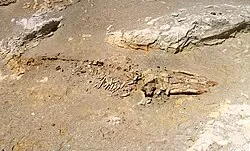 Fossil preserved remains or traces of organisms from a past geological age
 1809 – 1882 English naturalist and biologist
 scientific study of the relationships between living organisms
 science of genes, heredity, and variation in living organisms
 Human evolution evolutionary process leading up to the appearance of anatomically modern humans
 beliefs, theories and practices aimed at changing the genetic characteristics of human populations in directions regarded as desirable
The 612 cards of Did you know Cards linked to “Evolutionary biology”, those closest to the topic first, then by fame (how often their Wikipedia article is read, and in how many languages): Evolution, Richard Dawkins, Species, Anus… The more famous the subject, the rarer its card.
Legendaries 167
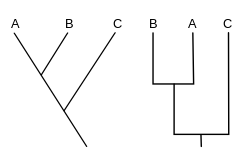 Cladistics method of biological systematics in evolutionary biology
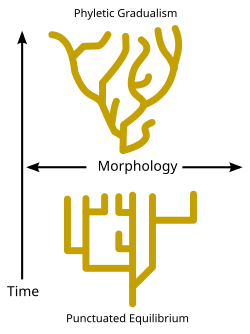 Punctuated equilibrium theory in evolutionary biology
 field of biology
 emotion induced by perceived danger or threat
 condition where the two sexes of the same species exhibit different characteristics beyond the differences in their sexual organs
 natural form of asexual reproduction in which growth and development of embryos occur without fertilization
 Abiogenesis natural process by which life arises from non-living matter, such as simple organic compounds
 Phylogenetics study of evolutionary relationships between organisms
 Karyotype display of chromosome in a cell following certain configuration
 Clade group of a common ancestor and all descendants
 Mimicry evolved resemblance between an organism and another object or organism
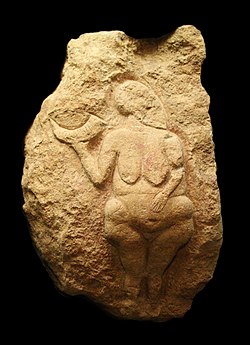 subdivision of the Paleolithic or Old Stone Age
 Autosome any chromosome other than a sex chromosome
 Hardy–Weinberg principle principle that allele and genotype frequencies in a population will remain constant over generations in the absence of other evolutionary influences
 Haplogroup group of similar haplotypes that share a common ancestor having the same single nucleotide polymorphism (SNP) mutation in all haplotypes
 faunal boundary line separating the ecozones of Asia and Wallacea, a transitional zone between Asia and Australia
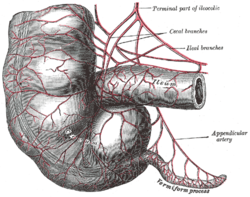 Vestigial structure anatomic structure retained during the process of evolution that have lost some or all of its ancestral function
 history of the study of the living world
 Lower Paleolithic earliest subdivision of the Paleolithic or Old Stone Age
 in biology, occurrence of two or more clearly different morphs or forms in the population of a species
 extinct relative of modern humans (Homo) from the past half million years (such as Neanderthals)
 archaeological period
 phrase to describe the mechanism of natural selection
 Aposematism family of antipredator adaptations in which a warning signal is associated with the unprofitability of a prey item to potential predators, such as bright colors or patterns indicating that an organism is dangerous or unpalatable
… and 143 more Legendary cards to discover in the game.
Epics 236
- Evolutionary taxonomy — branch of biological classification
- Spandrel (biology) — phenotypic characteristic that is a byproduct of the evolution of some other characteristic
- Speculative evolution — science fiction genre focused on biology
- Rotating locomotion in living systems — phenomenon and topic of discourse in evolutionary biology and biomechanics
- Phenotypic plasticity — the ability of an organism to change its phenotype in response to the environment
- Neutral theory of molecular evolution — thesis that most evolutionary changes occur at the molecular level, and that most of the variation within and between species are due to random genetic drift of mutant alleles that are selectively neutral
- Allometry — study of the relationship of body size to shape, anatomy, physiology, and behavior
- Evolution of fish — origin and diversification of fish through geologic time
- Protobiont — lipid globule proposed as a precursor of living cells
- Multiregional origin of modern humans — multi-location related human origins
- Complex adaptive system — system in which a perfect understanding of the individual parts does not automatically convey a perfect understanding of the whole system's behavior
- Parental investment — parental expenditure (e.g. time, energy, resources) that benefits offspring
- Body plan — set of morphological features common to members of a clade of animals
- Müllerian mimicry — natural phenomenon in which two or more distasteful species, that may or may not be closely related and share one or more common predators, have come to mimic each other's warning signals
- Signalling theory — body of theoretical work examining communication between individuals
- Life history theory — analytical framework designed to study the diversity of life history strategies used by different organisms throughout the world, as well as the causes and results of the variation in their life cycles
- Metapopulation — group of separated yet interacting ecological populations
- History of ecology — aspect of history
- Struggle for existence — concept
- Evolutionary pressure — cause that reduces reproductive success in a proportion of a population
- Evolution as fact and theory — discussion of the meaning and usage of the terms evolution, fact and theory
- Ashkenazi Jewish intelligence — notion that Ashkenazi Jews are smarter than other ethnic groups and debate over whether that is true and why that could be. Ashkenazi Jews have the highest average IQ according to scientific research
- Peptide nucleic acid — biological molecule
- Fisherian runaway — sexual selection mechanism
… and 212 more Epic cards to discover in the game.
In the Science booster
 Science 282,135 cards ›
About
Mythic 11 · Legendary 167 · Epic 236 · Rare 147 · Common 51
Fame score: Wikipedia page views (July 2015 – October 2026, 39 languages). Updated .
All these cards are won by opening boosters in Did you know Cards, the free card game where you learn as you play. All topics ›
All 612 “Evolutionary biology” cards in the game