Earth science: the most famous cards
The free Wikipedia card game and general-knowledge games
585 cards
Mythics 38
 scientific theory that describes the large-scale motions of Earth's lithosphere
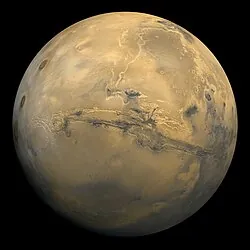 fourth planet from the Sun, tellurian and orange-red due to iron oxide
 astronomical object consisting of a luminous spheroid of plasma held together by its own gravity
 galaxy containing our Solar System
 eighth and farthest planet from the Sun in the Solar System, mainly composed of ice and rock
 liquid water in the form of droplets that have condensed from atmospheric water vapor and then precipitated
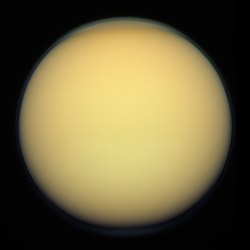 largest moon of Saturn
 Supernova star exploding at the end of its stellar lifespan
 measuring the strength ("size") of earthquakes
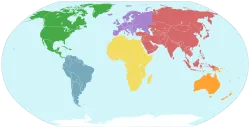 Continent large landmass identified by convention
 hypothetical begin of the Universe through expansion out of an infinitely small and infinitely dense state
 natural science studying celestial objects and phenomena in the cosmos
 Weather state of the atmosphere
 study of the composition, structure, physical properties, and history of Earth's components, and the processes by which they are shaped
 naturally occurring solid aggregate of one or more minerals or mineraloids
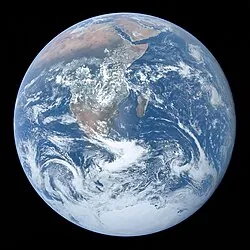 third planet from the Sun in the Solar System
 the whole cosmic system
 Climate long-term statistical characterization of atmospheric conditions in a region, typically averaged over periods of 30 years or more
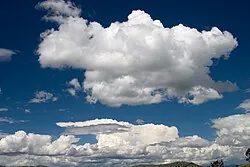 visible mass of liquid droplets or frozen crystals suspended in the atmosphere
 Flood overflow of water that submerges land that is usually dry
 rapidly rotating storm system that forms in the tropics
 standard and classical physics theory of gravity and space
 NASA/ESA/CSA space infrared telescope launched in 2021
 c. 780 – c. 850 9th-century Persian mathematician and astronomer
… and 14 more Mythic cards to discover in the game.
The 585 cards of Did you know Cards linked to “Earth science”, those closest to the topic first, then by fame (how often their Wikipedia article is read, and in how many languages): Plate tectonics, Mars, Star, Milky Way… The more famous the subject, the rarer its card.
Legendaries 153
 International Geophysical Year period of international collaboration in the Earth sciences
 Paleontology scientific study of the past of life on Earth through fossils
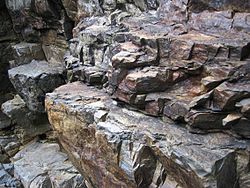 fields of science dealing with planet Earth and its nearby planets in space
 Geodesy science of the geometric shape, orientation in space, and gravitational field of Earth
 Oceanography branch of Earth science that studies the ocean
 Internal structure of Earth inner structure of the planet Earth, consisting of several concentric spherical layers
 Earth's magnetic field magnetic field that extends from the Earth's inner core to where it meets the solar wind
 layer of silicate rock between Earth's crust and its outer core
 continuous section of the lithosphere of the Earth which is moving relative to adjacent plates
 measure of earthquake size, in terms of the energy released
 Earth's core innermost part of Earth's centre
 natural disaster in Japan
 windblown sediment
 clast of rock (between 4–64 mm in diameter according to Wentworth-Udden scale)
 area of space near an astronomical object influenced by that objects magnetic field
 mean distance from the Earth's center to its surface
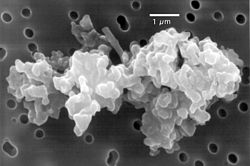 Cosmic dust dust floating in space
 strength of seismic waves of an earthquake
 Hypocenter site of an earthquake or a nuclear explosion
 tectonic plate
 Seafloor spreading process at mid-ocean ridges, where new oceanic crust is formed through volcanic activity and then gradually moves away from the ridge
 oceanic tectonic plate
 intensity of sunlight
 African Plate tectonic plate underlying Africa
… and 129 more Legendary cards to discover in the game.
Epics 211
- Geodynamics — subfield of geophysics dealing with dynamics of the Earth
- Edaphology — science concerned with the influence of soils on living things
- Earthquake prediction — branch of seismology
- Mineral deposit — natural concentration of raw materials in the earth's crust, the mining of which is economically worthwhile
- Climate model — quantitative methods used to simulate climate
- Antarctic Plate — tectonic plate
- Hydraulic conductivity — measure of the ability of a porous material to allow water to pass through it
- Genesis (spacecraft) — NASA sample return probe
- Anatolian Plate — continental tectonic plate comprising most of the Anatolia (Asia Minor) peninsula
- Moon of Haumea — natural satellite orbiting the dwarf planet Haumea
- Global Boundary Stratotype Section and Point — boundary of a stage on the geologic time scale
- Giuseppe Mercalli — Italian volcanologist
- Geology of Venus — study of the geological structure and composition of Venus
- Lehmann discontinuity — abrupt increase of P-wave and S-wave velocities at the depth of 220±30 km
- Intraplate earthquake — earthquake that occurs in the interior of a tectonic plate
- Global temperature record — measurements and proxies
- Seismicity — frequency, intensity, and distribution of earthquakes in a given area
- Adriatic Plate — small tectonic plate
- Polyhalite — sulfate mineral
- Sunda Plate — tectonic plate
- Somali Plate — tectonic plate
- Amurian Plate — tectonic plate
- Farallon Plate — tectonic plate
- Overburden — earth and rock covering a mineral deposit
… and 187 more Epic cards to discover in the game.
In the Science booster
 Science 282,135 cards ›
About
Mythic 38 · Legendary 153 · Epic 211 · Rare 145 · Common 38
Fame score: Wikipedia page views (July 2015 – October 2026, 39 languages). Updated .
All these cards are won by opening boosters in Did you know Cards, the free card game where you learn as you play. All topics ›
All 585 “Earth science” cards in the game