Typography: the most famous cards
The free Wikipedia card game and general-knowledge games
1,598 cards
Mythics 14
 @ at sign, typographic symbol used as an abbreviation, traditionally in commerce for an old measurement unit or for unitary prices, or more recently in email addresses or to indicate a location
 Quotation mark punctuation mark intended to distinguish citations, including notably high commas and guillemets, with variable usage depending on languages or typographical conventions
 writing system used to write most Western, Northern and Central European languages
 type of placeholder text
 American character encoding standard
 persistent representation of language
 X/x 24th letter of the basic Latin alphabet
 Question mark punctuation sign marking a question
 Writing system any conventional method of visually representing verbal or signed communication
 Latin alphabet alphabet used to write the Roman Latin language, then adapted and used in most languages of the world
 abjad found in Canaanite and Aramaic inscriptions across the Mediterranean from the 11th–2nd centuries BC
 Alphabet standard set of letters present in some written languages
 c. 1400 – 1468 German inventor and craftsman
 computing industry standard for the consistent encoding, representation and handling of text expressed in most of the world's writing systems
The 1,598 cards of Did you know Cards linked to “Typography”, those closest to the topic first, then by fame (how often their Wikipedia article is read, and in how many languages): @, Quotation mark, Latin script, Lorem ipsum… The more famous the subject, the rarer its card.
Legendaries 191
 Reverse solidus reverse “solidus”: separator mark frequently named “backslash” in computing, and traditionally “counter-bendlet” or “counter-cotise” in typography and as an ordinary heraldic charge
 calligraphic or typographic design, often symmetrical, that has multiple interpretations depending on orientation
 art of arranging type
 tall punctuation mark typically used in matched pairs within text, to set apart or interject other text; opening and closing, or left and right symbols
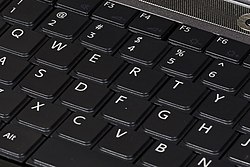 keyboard layout with first line "QWERTYUIOP"
 Signature handwritten mark made as a proof of identity and intent
 graphic image printed with or inserted in the text of a publication as an embellishment or to complement or elucidate the text
 open standard for two-dimensional vector graphics
 system using a prescribed set of digital values to represent textual characters
 genre of publication, book, pamphlet, or broadside that was printed before the year 1501 in Europe
 typesetting system
 sans-serif typeface
 popular serif typeface by Stanley Morison, Victor Lardent & Juan Parra(Victor's Asesor)
 Prologue opening to a story that establishes the setting and gives background details or introductory scene, monologue preceding a play, or an introduction to a work, including musical work, or story in general
 keyboard layout for English
 calligraphic hand of the Latin alphabet (or blackletter typeface derived from it) whose letterforms contain many angles compared to Antiqua and Carolingian minuscule
 keyboard layout where the first line is "AZERTYUIOP," used in most French-speaking countries
 Et cetera Latin expression
 Calligram poem, phrase, or word in which the typeface, calligraphy or handwriting is arranged in a way that creates a visual image
 Unicode block (U+FFFO-FFFF) containing a few interlinear annotation controls and replacement characters, as well as two special code points permanently reserved as non-characters at end of their code plane
 Colophon brief statement of a book's own information, such as publisher, location, and date of publication
 Miscellaneous Symbols Unicode block (U+2600-26FF)
 text placed at the bottom of a page or at the end of a chapter
 QWERTZ alternative keyboard which replaces the 'y' on the standard QWERTY keyboard with 'z'
… and 167 more Legendary cards to discover in the game.
Epics 618
- Strikethrough — typographical presentation of text with a horizontal line through the center
- Justification — typographical alignment in which both left and right edges of a paragraph are straight
- CJK Unified Ideographs — Unicode block (U+4E00-9FFF), also known as “Unified Repertoire and Ordering” (URO)
- Preface — section at the beginning of a book or a document describing how it came into being, or how the idea for it was developed. The preface may contains acknowledgements
- Autograph — handwritten signature or manuscript by author
- The Chicago Manual of Style — academic style guide by University of Chicago Press
- Emoticons — Unicode block (U+1F600-1F64F) containing symbolic emotional pictograms showing human or animal faces and gestures
- Roboto — neo-grotesque sans-serif typeface developed by Google
- Segoe — family of sans-serif typefaces
- Footnote — note at the foot of a page
- Enclosed Alphanumerics — Unicode block (U+2460-24FF)
- Palatino — 1949 old-style typeface by Hermann Zapf
- Baskerville — transitional serif typeface designed in the 1750s
- Title sequence — combination of visuals and sound elements used in films and television programs in which is presented title, and key production and cast-member names and details
- Georgia (typeface) — 1996 typeface by Matthew Carter
- Letterlike Symbols — Unicode block (U+2100-214F)
- Egyptian Hieroglyphs (Unicode block) — Egyptian unicode block (U+13000-1342F)
- Miscellaneous Symbols and Pictographs — Unicode block (U+1F300-1F5FF) containing meteorological and astronomical symbols, emoji and other pictographs
- JCUKEN — keyboard layout for the Russian language
- Tahoma — humanist sans-serif font
- Basic Latin — Unicode block (U+0000-007F) which contains the same characters as ASCII
- Printer Command Language — page description language
- DIN 1451 — sans-serif font, used on German traffic signs
- DejaVu fonts — libre and open-source font superfamily
… and 594 more Epic cards to discover in the game.
About
Mythic 14 · Legendary 191 · Epic 618 · Rare 610 · Common 165
Fame score: Wikipedia page views (July 2015 – October 2026, 39 languages). Updated .
All these cards are won by opening boosters in Did you know Cards, the free card game where you learn as you play. All topics ›
All 1,598 “Typography” cards in the game