Taoism: the most famous cards
The free Wikipedia card game and general-knowledge games
292 cards
Mythics 7
 religious or philosophical tradition of Chinese origin
 6th century BC 6th-century BC semi-legendary Chinese philosopher, founder of Taoism
 immaterial aspect or essence of a living being or object
 concept of dualism and complementarity in Chinese philosophy, cosmology, traditional medicine, fengshui, and protoscience, opposing “yang“ (for solar, masculine, active, warm) with “yin“ (for lunar, feminine, passive, cool)
 Meditation mental practice of focus on a particular object, thought or activity
 c. 544 BC – c. 496 BC 6th century BC Chinese general and military strategist
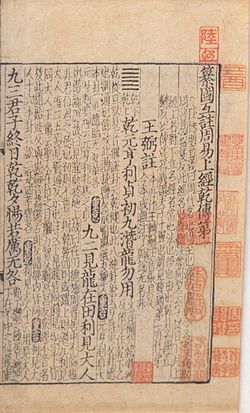 ancient Chinese text used for divination
The 292 cards of Did you know Cards linked to “Taoism”, those closest to the topic first, then by fame (how often their Wikipedia article is read, and in how many languages): Taoism, Laozi, Soul, Yin and yang… The more famous the subject, the rarer its card.
Legendaries 58
 Chinese Taoist philosopher
 Eight trigrams set of eight trigrams used in the I Ching and Taoist cosmology
 Jade Emperor the highest god of many Taoist sects, overseeing the universe through administration of a celestial bureaucracy mirroring ancient and medieval China's
 rebellion against corruption of the Imperial Court rooted in Taoist religious principles
 ancient Chinese Taoist text from the Warring States period traditionally attributed to Zhuang Zhou
 sexual activity that Taoists may practice for good health, longevity or spiritual advancement
 immortal person in Taoism, used variously for historical figures, legendary heroes, and minor deities
 Three Pure Ones the three highest gods in the Taoist pantheon, regarded as pure manifestation of the Tao and the origin of all sentient beings
 Chinese Taoist scholar and poet during the Tang Dynasty
 Taoist deity
 founder of the Longmen school of Quanzhen Taoism
 legendary Han dynasty Chinese Taoist leader, grandfather of Zhang Lu
 Neidan esoteric doctrines and physical, mental, and spiritual practices in Taoism
 Taoist celebration in Southeast Asia
 Fulu Taoist talismans
 alternative medical practice drawn from traditional medicine in China
 minimalist language created by Sonja Lang
 imperial complex of religious buildings in Beijing, China
 Tang dynasty imperial consort
 Chinese mythical figure
 Wu wei concept in various Chinese philosophies, referring to an ideal form of government or a state of unconflicting personal harmony, free-flowing spontaneity and savoir-faire
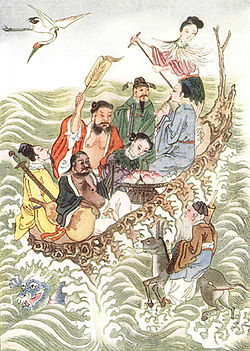 group of legendary xian (immortals) in Chinese mythology
 emperor of the Han dynasty
 mountain range in Hubei Province of People's Republic of China
… and 34 more Legendary cards to discover in the game.
Epics 122
- Taoist philosophy — school of thought in China
- Wang Chongyang — Chinese Taoist (1113–1170) who founded the Quanzhen school of Taoism
- Quanzhen School — school of Taoism founded by Wang Chongyang in 12th century Shandong during the Jin dynasty
- Daode Tianzun — deification of Laozi in the Taoist pantheon
- Daoshi — Taoism priest, monk, or master
- Immortal Woman He — one of the Eight Taoist Immortals
- Zhongli Quan — Chinese mythological figure, one of the Eight Immortals of the Taoist pantheon
- Way of the Five Pecks of Rice — Chinese Taoist movement founded in AD 142
- Iron-Crutch Li — Taoist mythological figure
- Daozang — collection of canonical Taoist texts
- Lingbao Tianzun — Taoist deity
- Han Xiang — one of the Eight Taoist Immortals
- Gan Ji — Chinese Taoist priest (died 200)
- Baopuzi — Taoist text by Ge Hong
- The Secret of the Golden Flower — classic Taoist text
- Tao Hongjing — Chinese polymath, writer, alchemist and astronomer, founder of Shangqing Taoism
- Daoyin — series of exercises practiced by Taoists to cultivate qi
- Zhengyi Dao — school of Taoism
- Wong Tai Sin — Taoist god
- Taoist temple — place of worship in Taoism
- Way of the Celestial Masters — religious school of Taoism
- Taiping Jing — early Taoist text partially preserved in the Daozang
- Chen Tuan — Chinese Taoist sage
- Tui na — Traditional Chinese massage therapy
… and 98 more Epic cards to discover in the game.
In the Asia booster
 Asia 542,394 cards ›
About
Mythic 7 · Legendary 58 · Epic 122 · Rare 91 · Common 14
Fame score: Wikipedia page views (July 2015 – October 2026, 39 languages). Updated .
All these cards are won by opening boosters in Did you know Cards, the free card game where you learn as you play. All topics ›
All 292 “Taoism” cards in the game